
12.1.2How can I build a polynomial that looks like ?
Taylor Polynomials About
A POLYNOMIAL APPROXIMATION OF
In Lesson 12.1.1, you approximated a function given information about its derivatives. However, what if you are not given the derivative information outright?
Generate an eighth-degree Taylor polynomial,
, to approximate about . An efficient way to determine the coefficient of each term is by organizing the derivatives in a table such as the one below.
Use your graphing calculator to graph
and on the same set of axes. On what interval is a good approximation of ? Use sigma notation to write an equation for
. Taylor polynomials are often used to approximate values of another function,
, at specific values of where is located near the “center.” As with any approximation, a certain amount of error is expected. That error is determined by .
Calculate the error ifis used to approximate:
TWO WAYS TO FIND A POLYNOMIAL APPROXIMATION FOR
Review each method outlined below. Then choose your favorite method to create a seventh-degree Taylor polynomial about
Method 1: Repeat the process you used in problem 12-16. Determine the initial value of the function and its first seven derivatives at
Method 2: You already know the equation of an eighth-degree Taylor polynomial for
Let
Represent
with sigma notation and in expanded form. Sketch
and over and . On what interval about will approximate within units? In other words, on what interval is the error, ?

Taylor Polynomials Centered at
If

Given
Write a fourth-degree Taylor polynomial,
, about for near . Write
using sigma notation.
Examine the graphs of
What is the relationship between the graphs of
and ? You are a contestant on “The Strongest Link” and you must name the coordinates of some point on
. What point do you name?
Examine the integrals below. Consider the multiple tools available for integrating and use the best strategy for each part. Evaluate each integral and briefly describe your method. Homework Help ✎
Consider the infinite series below. For each series, decide if it converges conditionally, converges absolutely, or diverges and justify your conclusion. State the tests you used. Homework Help ✎
A moving particle has position
What is the acceleration vector at
? For what time
does the velocity vector have a slope of ?
Multiple Choice: The graph at right shows the growth of a population
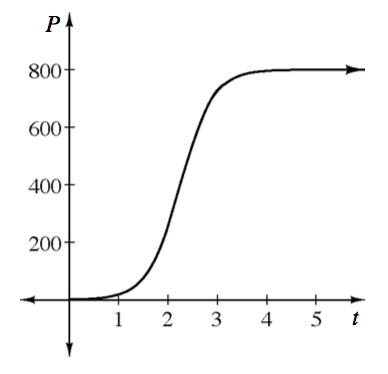
Given the logistic differential equation from problem 12-24, determine the size of the population when it is changing most rapidly. What is the significance of this value? Homework Help ✎
Multiple Choice: Which of the following equations can be used to determine where


